| << |
Magnetic loop on a wooden or metal mast ?
v20200623 13:45. 20260924.
large text arrial.
(C) The
use, publication, copy and modification of all info on this site is
only permitted for
non-commercial
purposes,
and thereby explicitly mentioning my radio amateur call sign
"PA0NHC", as the original writer / designer / photographer /publisher.
(C)
|
I have no experience with a metal mast for this magnetic loop. I
made an insulating wooden mast. But could a metal mast be used ?
From literature i
concluded that, as long as metal parts in the antenna
near
field do
not resonate, they do not harm the antenna radiation pattern nor the
antenna feed point impedance. That is the case, if
all these metal parts are not 1/2 lambda long or a multiple of 1/2
lambda long.
A metal loop mast is in very close distance with the antenna.
(Wikipedia
theory) : The mast is in the "reactive" part of the antenna near
field. If the mast should react with the antenna radiator, it will be noticed as a
wrong
antenna impedance at the
transmitter side of the feeder.
The insensitivity
of this loop antenna to metals near by seems to be
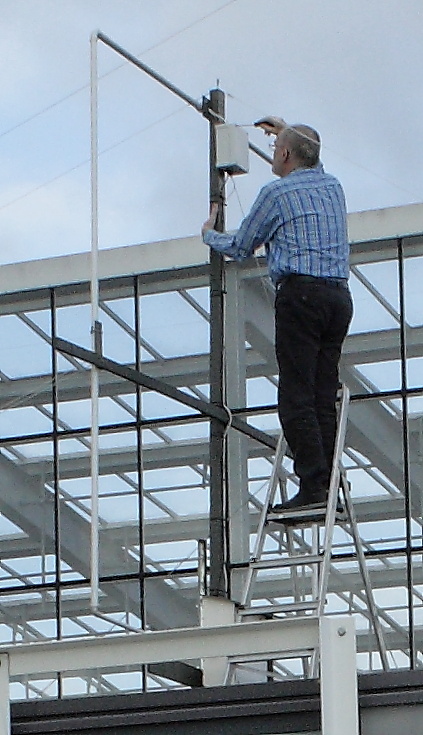
confirmed by the photo on the right.
- A long aluminum household ladder
stands was very close
to the loop.
- A 5m long aluminum mast is only 2m meters away from one side
of the loop.
Practice
:
When the ladder
was laid down, the best VSWR frequency, nor the VSWR value of the loop changed.
There was no reaction, no change in coupling.
The 3.2m
high ladder, and the 5m high mast, did not resonate at 3.5 MHz nor 7.2 MHz.
Their 1/2 lambda resonance
frequency was far higher.
The coax
feeder and the cable for relay and heating run both up on the wooden mast, in the vertical center
line of the loop. These cables have on both ends of the mast Common Mode Chokes,
and further away were ferrite clamps installed to prevent
common mode cable resonance. These cables also cannot resonate at the frequencies where the
loop is transmitting, and also do not influence the loop performance.
I
therefore presume that a metal mast is useable,
as long as it cannot resonate
by its length, INCLUDING the length of the to the mast connected safety
ground wire !!
Preventing
the build up of static charges, AND preventing mast +
ground wire resonance
could be accomplished by :
- Disconnecting the grounding wire at the antenna foot, and/or the mast.
- Connect the
screening of the feeder coax to the bottom end of the mast.
- Grounding the screening of the feeder at the start of the feeder (see
photo at the right).
-
Installing common mode chokes over the
feeder at max. distances of 1/4 lambda for 7MHz.
- Installing surge arrestors between the feeder coax and the grounding
point.
At the photo on the right, the coaxes
and command cables are grounded to the INTERNAL surface of the metal roof
construction. The steel roofconstruction was acting like a cage of faraday. In
case of lightning on the roof (it happened several times) the discharged
currects stayed outside the cage. So grounding of my radioroom equipment to the
inside of that cage was the best solution for me. That point had the lowest
system impedance. But disconnecing the N connectors in the radioroom is the
safest measure.
|